


Analytical Report Unlawful Deprivation of Liberty of Ukrainian and Foreign Nationals by the Occupation Forces of the Russian Federation: Monitoring Findings
Prepared within the framework of the “Systematic Fight Against Impunity” project implemented by Austausch e.V. (Federal Republic of Germany) in cooperation with the NGO Expert Group SOVA (Ukraine), the NGO Centre for Civil Liberties (Ukraine), the War Archive project (Ukraine), and independent experts (Kingdom of Norway)
The Analytical Report was prepared by:
· Larysa Pylhun – Deputy Chair of the Board of the NGO Expert Group OWL (Ukraine).
· Mykhailo Savva – Chair of the Board of the NGO Expert Group OWL, Expert at the Centre for Civil Liberties, Doctor of Political Sciences, Professor (Ukraine).
· Nataliia Yashchuk – Senior Manager at the Centre for Civil Liberties (Ukraine).
· Oleksandr Popkov – Lawyer (Kingdom of Norway).
Legal Foundations for Improving Conditions of Confinement and Securing the Release of Ukrainian Non-Combatants. 20
Appendix 1. Overview of the Results of the Solidarity Talks Discussion on Influencing Russian State Institutions Involved in Repressive State Policies. 28
Definitions of Key Terms
· Civilians Unlawfully Held by the Russian Side in Connection with the Armed Conflict – persons who permanently or for an extended period resided in the territory of Ukraine and were detained and deprived of their liberty without judicial decisions by Russian military personnel, representatives of special services, or groups and entities controlled by the Russian Federation in the occupied territories of Ukraine. Among the civilians unlawfully held are nationals of both Ukraine (who constitute the overwhelming majority) and other countries, including Belarus and Spain.
· Conflict-related sexualized violence (or Sexualized violence) refers to any acts of a sexual nature committed without a person's free and informed consent. The term is often used interchangeably with sexual violence, but it places particular emphasis on the purposes of such acts, including domination, humiliation, intimidation, or the destruction of an individual or a community.
· Conflict-Related Sexual Violence – rape, sexual slavery, enforced prostitution, forced pregnancy, forced abortion, enforced sterilization, forced marriage, and any other forms of sexual violence of comparable gravity against women, men, girls, and boys that are directly or indirectly linked to a conflict.
· Enforced Disappearance (as defined in the International Convention for the Protection of All Persons from Enforced Disappearance) – the arrest, detention, abduction or any other form of deprivation of liberty by agents of the State or by persons or groups of persons acting with the authorization, support or acquiescence of the State, followed by a refusal to acknowledge the deprivation of liberty or by concealment of the fate or whereabouts of the disappeared person, which place such a person outside the protection of the law.
· Monitoring – the observation of any processes (on an ongoing basis or over a specific period of time) for the purpose of their assessment, forecasting, and the development of recommendations.
· OSINT (Open Source Intelligence) – the collection, analysis, and systematization of information obtained from publicly available sources, including social media platforms, public registries, media sources, and geospatial mapping services.
· Oxygen Deprivation (Hypoxia) – an insufficient supply of oxygen to the body's tissues. Oxygen deprivation impairs normal bodily functions and, when prolonged, may result in cell death. This condition poses a serious risk to human health. Its consequences include a weakened immune system and the exacerbation of chronic diseases. Oxygen deprivation may result from environmental conditions, including confinement in a prison cell.
· Places of Forced and Unlawful Confinement – official and unofficial facilities, as well as other locations, where persons serving sentences, under investigation, awaiting deportation, or unlawfully deprived of liberty as a result of the Russian aggression against Ukraine from 2014 to the present are held. Such places include both official and unofficial facilities. All such facilities are located within the territory of the Russian Federation and in the temporarily occupied territories of Ukraine under Russian control.
· Protecting Powers – under the Geneva Conventions, States, whose duty is to safeguard the interests of the Parties to a conflict. For this purpose, Protecting Powers may appoint, in addition to their diplomatic or consular staff, delegates from among their own nationals or the nationals of other neutral States. Such delegates are subject to the approval of the State in which they are to carry out their duties. The Parties to the conflict shall facilitate, to the greatest extent possible, the work of the representatives or delegates of the Protecting Powers.
· Sensory Deprivation – the partial or complete reduction of external stimuli affecting one or more of a person's senses. It results in a decreased flow of nerve impulses to the central nervous system. Sensory deprivation may occur when individuals are isolated in a confined space, such as a detention cell. Prolonged sensory deprivation leads to a loss of connection with reality, depression, impaired concentration, and may result in post-traumatic stress disorder.
· Substitute Organization – in international humanitarian law (IHL), an impartial humanitarian organization (for example, the International Committee of the Red Cross) that performs the functions of a Protecting Power in monitoring compliance with the Geneva Conventions. A Substitute Organization assumes responsibility for the protection of war victims when the Parties to a conflict have not designated a Protecting Power.
· Torture (as defined in the Convention against Torture and Other Cruel, Inhuman or Degrading Treatment or Punishment) – any act by which severe pain or suffering, whether physical or mental, is intentionally inflicted on a person for such purposes as obtaining from him or a third person information or a confession, punishing him for an act he or a third person has committed or is suspected of having committed, or intimidating or coercing him or a third person, or for any reason based on discrimination of any kind, when such pain or suffering is inflicted by or at the instigation of or with the consent or acquiescence of a public official or other person acting in an official capacity. It does not include pain or suffering arising only from, inherent in or incidental to lawful sanctions.
· Universal Jurisdiction – criminal jurisdiction based on the nature of the crime, regardless of the territory where it was committed, the nationality of the suspected or convicted offender, the nationality of the victim, or any other connection to the State exercising such jurisdiction. A State may exercise universal jurisdiction over a crime committed by a foreign national against another foreign national outside the territory of that State.
· Unlawful Deprivation of Liberty – the forcible confinement of a person without their consent and without legal grounds, in violation of the right to personal liberty and security. It constitutes a serious human rights violation. Unlawful deprivation of liberty includes confinement, arrest, or abduction carried out by both State and non-State actors.
Introduction
This analytical report was prepared in response to a demand within Ukrainian society for greater awareness of the issues associated with the unlawful deprivation of liberty of Ukrainian civilians (non-combatants) by the Russian occupation forces. This demand is reflected in appeals submitted to Ukrainian human rights organizations by victims of such unlawful deprivation of liberty and their relatives, as well as in publications in the media, social media, and other public sources. It concerns both an assessment of the problem and recommendations for addressing it.
This analytical report was prepared through the active cooperation of a number of Ukrainian human rights organizations working in support of victims of unlawful deprivation of liberty, as well as the Coordination Headquarters for the Treatment of Prisoners of War.
Executive Summary
Monitoring of unlawful deprivation of liberty confirms the widespread and systematic nature of such practices. Systematic violations of rights and the commission of crimes against Ukrainian civilians and prisoners of war, including unlawful deprivation of liberty, are not isolated acts committed by individual perpetrators but rather a matter of State policy pursued by the Russian regime.
The Russian regime has taken no voluntary steps toward the large-scale release of Ukrainian non-combatants or the improvement of their situation. We have no grounds to expect such voluntary actions in the future.
The Russian regime has established a system of normative acts under which Russian officials formalize the unlawful deprivation of liberty of Ukrainian non-combatants. These normative acts have not been made public, and their application therefore contradicts both Russia’s international obligations and the Constitution of the Russian Federation.
The Russian authorities fail to comply with the requirements of international humanitarian law regarding Ukrainian non-combatants. Improvements in detention conditions and the release of unlawfully held Ukrainians are possible only through measures that compel the Russian regime to take such actions. Several mechanisms of such compulsion exist, including investigations and criminal prosecutions in Ukraine, the exercise of universal jurisdiction by other States, and the imposition of restrictive measures (sanctions) against Russian officials and organizations.
One of the available means of exerting such pressure is the imposition of sanctions, that is, restrictive measures. Until early 2025, very limited progress had been made in imposing sanctions for torture and unlawful deprivation of liberty.
The resolutions adopted by the European Parliament in 2025 and 2026 have created opportunities to advocate for the imposition of EU and national sanctions (restrictive measures) against Russian State bodies responsible for implementing State policy regarding Ukrainians unlawfully deprived of liberty, including the Military Police of the Ministry of Defence, the Federal Security Service (FSB), and the Federal Penitentiary Service (FSIN).
The design of sanctions in response to unlawful deprivation of liberty should be based on the understanding that such measures are neither punishment nor retaliation. Restrictive measures are a means of preventing further violations and securing the release of unlawfully held persons.
The development and implementation of sanctions require continuous cooperation among the executive bodies of the European Union, the governments of interested countries (including those outside the EU), and representatives of the Ukrainian human rights community.
It is necessary to continue monitoring unlawful detention and unlawful deprivation of liberty and to further improve the monitoring system through the introduction of OSINT tools.
Monitoring Methodology
The monitoring methodology includes:
· a methodology for collecting and analyzing information on unlawful deprivation of liberty;
· a methodology for developing recommendations.
Methodology for Collecting and Analyzing Information on Unlawful Deprivation of Liberty
Information on the unlawful deprivation of liberty of civilians is collected and analyzed through the combined use of open-source information, field interviews, and information provided by family members or other individuals when contacting human rights organizations.
This combined approach makes it possible to verify information from different sources and minimize the risk of errors. Russia does not acknowledge the deprivation of liberty of a significant number of civilians and also practices holding them in custody without access to lawyers, relatives, or international organizations. As a result, all persons unlawfully deprived of liberty are held in a state of incommunicado detention. This term refers to the absence of any official information regarding a person's whereabouts, legal status, or state of health. Most importantly, persons held in this state are deprived of the opportunity to communicate with their relatives.
Monitoring Tools
1. OSINT Monitoring of Open Sources
Monitoring of open sources is the most accessible method of information collection, while at the same time requiring the use of specialized tools. Information is collected from:
· Telegram channels of occupation administrations;
· Telegram channels of Russian law enforcement and security agencies;
· Russian national and regional media outlets;
· pro-government and propaganda channels in Russia;
· video-sharing platforms and social media (e.g., TikTok, YouTube, etc.);
· official statements published by Russian law enforcement and security agencies on their online resources;
· publications issued by the press services of Russian courts on their websites, Telegram channels, and other resources;
· unofficial publications by pro-government and military bloggers, as well as propagandists.
These resources periodically publish reports on the detention of individuals on accusations of “espionage,” “treason,” “terrorism,” or “extremism.” In most cases, such reports do not contain names or other information that would allow the person concerned to be identified. In many instances, only the fact of detention or the initiation of criminal proceedings is reported. An example is the publication entitled “Crimea resident detained for sharing information about military facilities with Security Service of Ukraine – FSB”[1].
After identifying such reports, human rights defenders documenting these violations:
· record the fact of detention;
· collect additional information through open sources;
· seek to establish the identity of the detained person.
Once a person has been identified, further information is sought through the monitoring of Russian court registries and criminal case databases. The number of reports on the detention of individuals exceeds the number of initiated criminal cases. This indicates that a large number of people are being held in captivity without any criminal proceedings being instituted against them.
For routine daily monitoring, it is advisable to use modern technologies, including artificial intelligence language models. Independently reviewing each individual source of information (for example, media outlets) requires significant time and resources. Even the assistance of volunteers does not make it possible to review all relevant resources in a timely manner. As a result, important and, in some cases, life-saving information may be missed.
The use of AI tools makes it possible to establish automated searches for relevant information, refine search parameters, and analyze the results. AI tools are financially accessible and can be used at relatively low cost.
2. Monitoring Criminal Cases in the Russian Federation
The next stage involves monitoring criminal proceedings in the Russian Federation, carried out in cooperation with interested experts and organizations from different countries. The following sources are examined:
· court registries (the State Automated System “Pravosudie”);
· communications issued by prosecutorial and investigative authorities;
· publications in Russian media outlets;
· court decisions ordering detention or extending pre-trial detention measures.
This makes it possible to identify the detained person, determine the relevant article of the Criminal Code, and confirm the fact of detention.
In a significant number of cases, criminal proceedings are initiated under the following articles of the Criminal Code of the Russian Federation:
· Articles 276/275 – “Espionage” / “High Treason”, depending on the nationality of the accused;
· Article 205 – “Terrorist Act”;
· Article 105 – “Murder”;
· Article 208 – “Organization of an Illegal Armed Formation or Participation Therein, as well as Participation in an Armed Conflict or Hostilities for Purposes Contrary to the Interests of the Russian Federation”.[2]
At the same time, detention often takes place long before a criminal case is officially opened, meaning that the person is effectively held in a state of incommunicado[3] detention.
During some court proceedings, defense lawyers or defendants publicly state that the official date of detention does not correspond to the actual date and that the individual was detained much earlier. This makes it possible to document cases of unlawful detention prior to the initiation of criminal proceedings.
3. Interviews with Civilians and Prisoners of War Released from Russian Captivity
The most important source of information is interviews with civilians and military personnel released from Russian captivity. Individuals who were held in places of detention within the territory of the Russian Federation and the temporarily occupied territories of Ukraine often provide information about:
· persons with whom they shared a cell, including their names;
· the approximate date of detention;
· the conditions of confinement;
· transfers of detainees to other places of confinement.
The Russian authorities do not distinguish between Ukrainian civilians and prisoners of war, classifying all of them as persons “detained for opposing the special military operation.” Civilians and prisoners of war are often held together.
Testimonies provided by persons released from captivity make it possible to:
· identify previously unknown detainees;
· verify information concerning already known individuals;
· determine places of confinement.
According to journalistic investigations, a significant number of civilians are held in special closed sections of pre-trial detention centres (SIZOs) or in secret detention facilities where their presence is not officially recorded.[4]
4. Appeals from Families of Persons Unlawfully Deprived of Liberty
Another important source of information is appeals submitted by relatives of civilians who disappeared in the occupied territories. These may be territories that have already been liberated or that remain under occupation. Family members usually provide basic information, including the date of disappearance, the person’s last known location, the circumstances of the detention, and witness testimonies. In many cases, witnesses report that the person was detained by Russian military personnel, officers of the Federal Security Service (FSB), or individuals in unmarked uniforms. Following such detentions, the whereabouts of the person usually remain unknown.
As part of documenting this crime, testimonies from relatives are collected, information is verified through other sources, and searches are conducted in Russian court registries.
Information on places where persons unlawfully deprived of liberty are held can be obtained from testimonies of Ukrainians released from captivity and from the monitoring of criminal proceedings. The analyzed sources indicate that a significant proportion of civilians are held for extended periods:
· in pre-trial detention centres (SIZOs) and other facilities of the Federal Penitentiary Service (FSIN) in the occupied territories and within the Russian Federation. Prisoners of war are also held in these facilities;
· in locations not intended for the detention of persons, including basements, garages, warehouses, and similar premises.
Investigations conducted by Ukrainian, foreign, and international media confirm the existence of a network of facilities where civilians are held and subjected to torture, psychological pressure, and isolation from the outside world. [5]
The above-mentioned sources of information and information-gathering methods are used by several Ukrainian organizations that cooperate in the search for information, including the War Archive project, the Centre for Civil Liberties, and the NGO Expert Group SOVA. This cooperation made it possible to collect information on unlawful deprivation of liberty since the beginning of the Russian Federation’s full-scale aggression against Ukraine (February 2022) for the purposes of this analytical report.
To verify certain facts related to the unlawful confinement of individuals, the authors used official documents of Russian State authorities that were made public by the international project “Gulagu.net”. The project published the following statement: “Our possession includes an archive of internal documents of the Ministry of Defence of the Russian Federation and the Federal Penitentiary Service (FSIN) marked ‘For Official Use Only’. These materials confirm:
· the unlawful confinement of thousands of Ukrainian citizens held as prisoners of war on the territory of the Russian Federation;
· widespread torture, coercion, and pressure aimed at obtaining statements;
· the complete absence of judicial decisions and legal status;
· coordination among the Federal Security Service (FSB), the Federal Penitentiary Service (FSIN), the Investigative Committee, the Prosecutor’s Office, and military commandant’s offices”.[6]
Limitations of the Methodology
The actual number of civilians held in a state of incommunicado detention significantly exceeds the number of documented cases[7], as there are a number of limitations affecting the ability to obtain information about all persons unlawfully deprived of liberty:
· the Russian Federation conceals any information concerning persons unlawfully deprived of liberty;
· the Russian Federation does not grant international organizations access to places of confinement (including the International Committee of the Red Cross);
· a significant number of individuals are held in captivity without criminal proceedings being initiated against them, making it impossible to obtain information about their whereabouts and conditions of confinement;
· families of persons unlawfully deprived of liberty are often afraid to report disappearances in occupied territories due to the risk of reprisals.
2. Methodology for Developing Recommendations
The development of recommendations concerning the search for information about persons unlawfully deprived of liberty, the improvement of their conditions of confinement, and their release constitutes the most important component of monitoring unlawful deprivation of liberty and analyzing information collected regarding civilians and prisoners of war.
The results of monitoring do not in themselves provide ready-made recommendations. The development of recommendations was carried out in accordance with a specific methodology. This methodology is based primarily on a series of expert discussions. Such discussions significantly broaden the range of possible solutions to existing problems and enhance the objectivity of the recommendations through the participation of experts with diverse professional backgrounds and experience.
In the process of developing recommendations, the authors of this analytical report conducted three types of expert discussions:
Expert Discussion with the Participation of Experts from the Centre for Civil Liberties
Such a discussion took place on 16 February 2026 as a meeting of the organization’s Expert Council. The event was devoted to restrictive measures (sanctions) against officials and organizations of the Russian Federation responsible for the unlawful deprivation of liberty of Ukrainian nationals.
Expert Discussions with Experts from Different Countries of the Organization for Security and Co-operation in Europe (OSCE) Region
These expert discussions were held in the format of the human rights dialogue platform Solidarity Talks.
On 21 January 2026, an expert meeting entitled “Monitoring Cases of Unlawful Deprivation of Liberty by the Russian Regime: How Can the Effectiveness of Human Rights Protection Be Improved?” took place. Twenty-five participants from eleven countries attended the meeting. The principal speakers were:
· Nataliia Yashchuk, Chair of the Board of the non-profit organization Institute for Communication Solutions, Ukraine;
· Ihor Michnyk, Director of Austausch e.V., Federal Republic of Germany;
· Mykhailo Savva, Chair of the Board of the NGO Expert Group SOVA, Doctor of Political Sciences, Ukraine.
During the event, the experts proposed appealing to the European Parliament to call upon the institutions of the European Union and the EU Member States to impose sanctions for unlawful deprivation of liberty. On 4 February 2026, these proposals were submitted for discussion to Members of the European Parliament who were the authors of the draft resolution “Four Years of Russia’s War of Aggression against Ukraine and European Contributions to a Just Peace and Sustained Security for Ukraine”.
The proposals developed during the expert meeting were subsequently incorporated into European Parliament Resolution 2026/2599(RSP) of 24 February 2026.
On 18 February 2026, a subsequent Solidarity Talks expert meeting was held under the title “State Organizations Violating International Law during Wartime: How Can They Be Influenced?”. Twenty-eight participants from fifteen countries took part in the discussion. The speakers were:
· Oleksandra Romantsova, Executive Director of the Centre for Civil Liberties;
· Hlib Bohush, Candidate of Legal Sciences, Germany;
· Kostiantyn Zadoia, Candidate of Legal Sciences, Associate Professor, Ukraine;
· Dmytro Zakhvatov, Lawyer, Lithuania–Russia.
The event was devoted to discussing the appropriateness, effectiveness, and limitations of sanctions against State organizations that systematically participate in the implementation of criminal policies of the State. A brief summary of the discussion is provided in Annex 1.
Participation in Expert Discussions Initiated and Organized by Other Ukrainian Organizations
One such discussion took place on 7 April 2026 and was devoted to the topic “Restrictions on Human Rights in the Territories of Ukraine Occupied by the Russian Federation”. Mykhailo Savva participated in this discussion.
What Is Happening? (Description of the Problem)
The Russian Federation has made war crimes and crimes against humanity a method of warfare and a means of controlling the population of occupied territories. Such crimes are widespread. According to the Office of the Prosecutor General of Ukraine, as of May 2026, a total of 235,558 war crimes and crimes of aggression had been registered[8].
As part of the Russian Federation’s State policy toward civilians, the following crimes are systematically committed:
· imprisonment or other severe deprivation of physical liberty in violation of fundamental rules of international law;
· enforced disappearance of persons;
· unlawful deprivation of liberty.
These crimes are defined in the Rome Statute.
According to preliminary estimates, up to 17,000 civilians are being held by the Russian Federation in connection with the conflict. The presence of approximately 1,900 civilians in places of forced and unlawful confinement has been confirmed by various sources. Individuals in this group have been identified on the basis of information provided by the International Committee of the Red Cross (ICRC), responses from representatives of the Russian Federation to inquiries submitted by relatives, and testimonies of civilians and prisoners of war who have returned to Ukraine.
The imprecision of estimates regarding the number of civilians deprived of liberty is caused by the Russian Federation’s refusal to provide information about all such persons or to grant representatives of the International Committee of the Red Cross or other international organizations access to them.
The Russian Federation violates the requirements of international humanitarian law (IHL), which:
· grant detainees the right to send letters to their relatives during armed conflict;
· require Russia to provide representatives of the International Committee of the Red Cross (ICRC) with access to all detainees.
Since the beginning of Russia’s military aggression against Ukraine in 2014, no Protecting Power has been designated. The International Committee of the Red Cross operates under conditions of Russia’s systematic failure to comply with its obligations regarding the humane treatment of detainees. In particular, the Russian Federation does not ensure communication between these persons and their relatives. As a result, international organizations and the Ukrainian authorities do not possess complete information about detained Ukrainian nationals.
In June–July 2025, the National Union of Journalists of Ukraine (NUJU) conducted a survey of 94 families of civilians unlawfully deprived of liberty. The main findings were as follows: 75% of families do not know the whereabouts of their relatives, 60% receive no official information at all regarding their cases, 89% of cases of abduction have been confirmed by the Ukrainian side, but only 33% by the Russian side[9].
Under international humanitarian law, the International Committee of the Red Cross (ICRC) has special powers to protect civilians affected by international armed conflicts. However, these powers have not been fully exercised. For example, to date, the ICRC has not been granted access to all places of forced and unlawful confinement where Ukrainian civilians are held. This situation results from the actions of the Russian Federation, which has ignored ICRC requests for such visits. In the absence of Protecting Powers, the ICRC has not proposed to the parties to the conflict that it be accepted as a Substitute Organization.
The Russian Federation has been using the practice of unlawfully depriving Ukrainians of their liberty since 2014. This practice expanded significantly following the start of the full-scale invasion. Many civilians currently deprived of their liberty in the Russian Federation and in the occupied territories were detained by the occupying forces as early as February and March 2022. This occurred, among other places, in the Kyiv, Sumy, Chernihiv, Kharkiv, and Kherson regions during their occupation. These settlements were liberated from Russian occupation long ago. Consequently, there can be no justification for the continued deprivation of liberty of these individuals. Nevertheless, they have still not been released.
In addition to unlawful deprivation of liberty in the occupied territories of Ukraine, the Russian authorities also detain Ukrainians within the territory of the Russian Federation. In the latter case, such detentions generally occur under two principal schemes.
The first scheme: the detention of Ukrainian citizens residing in the Russian Federation. A large number of people were forced to leave the occupied territories of Ukraine for the Russian Federation. In most cases, these individuals had no choice regarding their destination. The number of Ukrainians who relocated to the Russian Federation is estimated at 2.8 million people.[10] In addition, a significant number of Ukrainian citizens had been permanently residing in the Russian Federation long before the start of the full-scale aggression. Some Ukrainian citizens permanently residing in the Russian Federation become victims of unlawful deprivation of liberty based on suspicions of disloyalty to the Russian regime.
The second scheme: the detention of Ukrainian citizens and residents travelling to third countries through the territory of the Russian Federation. Only persons carrying Ukrainian documents are subjected, at Russian border crossings, to a special mandatory procedure involving interviews and document checks before being allowed to proceed to a third country. This procedure is carried out by unidentified individuals who wear no insignia and do not identify themselves. They examine documents, review information stored on electronic devices (phones, laptops, etc.), inspect tattoos, and ask questions intended to assess loyalty to the Russian regime.
According to our estimates, approximately 1% of Ukrainians attempting to leave the Russian Federation are deprived of their liberty as a result of these screening procedures. This scheme of deprivation of liberty represents one of the forms of detention associated with so-called “filtration” measures.[11]
Civilians detained in Ukraine are held in the Russian Federation and in the occupied territories in custodial facilities operated by three federal agencies:
· the Federal Penitentiary Service (FSIN) (prisons, correctional colonies, including settlement colonies, pre-trial detention centres, and correctional centres). FSIN forms part of the system of bodies subordinate to the Ministry of Justice of the Russian Federation;
· the Ministry of Internal Affairs (temporary detention centres for foreign nationals);
· the Ministry of Defence (guardhouses attached to military garrison commandant’s offices).
In all such facilities, Ukrainians are segregated from Russian prisoners and detainees and are held in separate buildings, on isolated floors, or in dedicated sections of prison facilities. It is likely that formal responsibility for the locations where Ukrainians (both civilians and prisoners of war) are held rests not with the institutions of the Federal Penitentiary Service or the Ministry of Internal Affairs, but with the Military Police of the Ministry of Defence. This conclusion can be drawn from materials contained in certain criminal cases involving Ukrainian non-combatants.
In the occupied territories, many Ukrainian civilians are unlawfully held, without any formal record of detention, in unofficial facilities not intended for that purpose, including basements, warehouses, garages, and similar locations. Some individuals are released from such places of unlawful confinement without having their identity documents returned to them. This practice appears intended to prevent them from leaving the Russian Federation and to facilitate their renewed deprivation of liberty if deemed necessary.
One such case was described by Serhii Voronkov, who nevertheless managed to escape from the Russian Federation.[12] Practices of deprivation of liberty without formal registration are extremely diverse. In Enerhodar, Zaporizhzhia Region, according to local residents, several employees of the Zaporizhzhia Nuclear Power Plant (ZNPP) were held for several months after the beginning of the occupation in a basement beneath the police department building.
The deprivation of liberty of these individuals is unlawful, as a person may not legally be held in a temporary detention facility for such a prolonged period.
A considerable number of Ukrainian non-combatants are held in official places of forced confinement, including pre-trial detention centres (SIZOs), correctional colonies, prisons, and other facilities. In most cases (except for civilians against whom criminal proceedings have been initiated), Ukrainian non-combatants are held in places of forced confinement in the occupied territories and in the Russian Federation without judicial decisions.
The Russian regime has introduced into practice a system of normative legal acts used to formalize the deprivation of liberty of Ukrainian nationals. These documents have not been made public. At the same time, they directly affect human rights. Under Article 15(3) of the Constitution of the Russian Federation, not only laws but also any normative acts affecting the rights and obligations of individuals must be officially published. Normative acts that have not been published may not be applied and produce no legal consequences. The application of such acts constitutes a violation of constitutional rights. Thus, the entire system used to provide a legal framework for the deprivation of liberty of Ukrainians is unlawful even under Russian law.
What do we know about the Russian system of normative legal acts on the basis of which Ukrainians are deprived of their liberty?
Citizens of Ukraine and other countries are detained “for obstructing the conduct of the special military operation within the framework of Criminal Case No. 201/837072-14 concerning the use by representatives of the Ukrainian security structures of means and methods of warfare prohibited by the Geneva Convention of 12 August 1949 and Protocol II thereto” (quotation reproduced here does not reflect the views of the authors of this analytical report regarding the contents of this criminal case).
This criminal case is being investigated by the Main Investigative Directorate of the Investigative Committee of the Russian Federation. Russian sources state that “the procedure for detaining combatants and extending the periods of their detention at collection points is regulated by normative legal acts of the Russian Federation. These powers are exercised by the heads of military police bodies.”
It should be emphasized that this quotation describes the detention of a civilian. The individual concerned did not participate in hostilities. Thus, the Russian regime treats Ukrainian civilians (non-combatants) as combatants.
The formal legal basis for the deprivation of liberty of Ukrainian nationals (both civilians and prisoners of war) consists of resolution issued by military commandants of Russian military garrisons. Military commandant’s offices are structural units of the Military Police of the Ministry of Defence of the Russian Federation.
Among the documents made public by the international project Gulagu.net is an order entitled “On the Placement of a Person Opposing the Special Military Operation Conducted in Accordance with the Procedure Established by the President of the Russian Federation in a Pre-Trial Detention Centre, a Facility Operating under the Regime of a Pre-Trial Detention Centre, a Correctional Institution, or a Transit and Transfer Point of the Penal Enforcement System of the Russian Federation,” dated 17 April 2022 and signed by Captain O.M. Hudynchuk, bearing the seal of the Military Commandant’s Office of the Belgorod Garrison.
On the same date, 17 April 2022, an “Acceptance and Transfer Act” was signed, recording that I.V. Khokhlov, Duty Assistant to the Head of the Transit and Transfer Point of Correctional Colony No. 6 of the Federal Penitentiary Service Directorate for Belgorod Region, accepted from A.E. Bakhtibekov, a representative of the Armed Forces of the Russian Federation, a citizen of Ukraine classified as a “person opposing the special military operation.” This document bears the classification marking “For Official Use Only” (Russian abbreviation: DSP).
Resolution authorizing the transfer of “persons opposing the special military operation” from one place of forced confinement to another were also signed by military commandants. One such order, issued by the same Captain O.M. Hudynchuk on 19 April 2022, authorized the transfer of a “person opposing the special military operation” from Correctional Colony No. 6 to Pre-Trial Detention Centre No. 2 of the Federal Penitentiary Service Directorate for Belgorod Region.
Resolutions extending the periods of detention of Ukrainians are likewise signed by military commandants. In May or June 2022, the Head of the Main Directorate of the Military Police of the Ministry of Defence of the Russian Federation circulated an instruction to military commandants assigning them responsibility for extending the detention periods of persons detained “for opposing the special military operation.” For this purpose, military commandants were granted authority to sign the relevant resolutions.
This instruction was implemented in practice. Human rights defenders have made public an order entitled “On the Extension of the Period of Detention,” dated 3 March 2023 and signed by Lieutenant Colonel V. Orlov, Military Commandant of the Military Commandant’s Office of the City of Ivanovo. By this document, the period of detention was extended until 16 July 2023.
In correspondence between various Russian State bodies, the detention of Ukrainian civilians is referred to as “filtration measures.” At the same time, correspondence between persons deprived of liberty and their relatives is not permitted “until the completion of filtration measures.” In some cases, such “measures” have continued for more than four years.
The heads of institutions of the Federal Penitentiary Service (FSIN) to which Ukrainians were transferred sent notifications to prosecutors of the relevant constituent entities of the Russian Federation (republics, territories, and regions). The Gulagu.net project has published one such notification. It was sent on 1 October 2022 by D.Yu. Mokhov, Acting Head of Pre-Trial Detention Centre No. 2 of the Federal Penitentiary Service Directorate for Ivanovo Region, to the Prosecutor of Ivanovo Region. The existence of such notifications raises the question of the responsibility of Russian prosecutors for the unlawful deprivation of liberty of Ukrainian nationals who are non-combatants.
Where a citizen of Ukraine is deprived of liberty within the territory of the Russian Federation not as a result of previously initiated criminal proceedings but as a consequence of “filtration,” the deprivation of liberty is ordered by the head of the regional directorate of the Federal Security Service (FSB) in the relevant constituent entity of the Russian Federation (republic, territory, or region). Periodically (once every few months), the same officials issue resolutions extending the period of detention.
Such decisions cannot be appealed, nor is it possible to determine the legal grounds for the detention. As noted above, the relevant normative legal acts have never been made public, despite directly affecting fundamental human rights. At the same time, Article 15(3) of the Constitution of the Russian Federation provides: “Any normative legal acts affecting the rights, freedoms and duties of a person and citizen may not be applied unless they have been officially published for general information.”
Furthermore, Article 22 of the Constitution of the Russian Federation does not permit detention for more than 48 hours without a judicial decision. Thus, the legal regime governing the deprivation of liberty of Ukrainian non-combatants is unlawful not only under international law but also under the Constitution of the Russian Federation itself.
Many heads of institutions of the Federal Penitentiary Service (FSIN), including pre-trial detention centres, correctional colonies, and other facilities, are aware that their institutions are being used for the unlawful confinement of Ukrainian civilians. The unlawful deprivation of liberty of civilians creates significant risks for the Federal Penitentiary Service and its personnel, including international investigations, sanctions (restrictive measures), criminal prosecution by Ukraine and other States, proceedings before the International Criminal Court, and potential criminal liability within the Russian Federation in the event of a change in the political regime.
At the same time, some FSIN personnel view the unlawful deprivation of liberty of large numbers of Ukrainian civilians as an opportunity for career advancement through compliance with manifestly unlawful instructions issued by FSIN leadership and officers of the Federal Security Service (FSB). In addition, an increase in the number of persons held in FSIN facilities results in increased funding for such institutions and, consequently, creates additional opportunities for corruption.
According to information provided by the Ukrainian Coordination Headquarters for the Treatment of Prisoners of War, approximately 200 places of forced confinement holding Ukrainian civilians have been identified. The exact number of such facilities may change as unlawfully detained persons are transferred from one place of confinement to another. It is likely that the Russian authorities intend to reduce the number of facilities used to hold Ukrainians in order to simplify logistical arrangements. Maintaining approximately 200 places of confinement with separate areas designated for Ukrainians is highly complex. It may therefore be assumed that Ukrainian prisoners of war and civilians will eventually be concentrated in several dozen places of forced confinement.
Russian courts routinely reject complaints submitted by relatives of persons unlawfully deprived of liberty. Evidence of this practice can be found in the appellate ruling of the Moscow City Court of 29 January 2025 in Administrative Case No. 33a-813/2025, as well as in other judicial decisions cited below.
The relatives of detained persons appealed against the ruling issued by a judge of the Presnensky District Court of Moscow on 13 September 2024. By that ruling, the court returned their application seeking recognition of the unlawful inaction of the Ministry of Defence of the Russian Federation, namely its failure to ensure communication between detained persons and their relatives. The applicants requested that the court declare such inaction unlawful and order the Ministry to remedy the violation by ensuring communication.
The District Court apparently did not know how to deal with the case. The complaint was well-founded, but the court was unwilling to issue a decision that would have conflicted with State policy. As a result, the application was returned to the applicants without consideration of its merits.
The Moscow City Court was subsequently required to address the substance of the complaint. It dismissed the claims of the relatives, relying on the Geneva Conventions. According to the court, issues relating to the denial of communication between detained persons and their relatives were subject to a different procedure established by the Geneva Conventions. On that basis, the court concluded that the claims were not subject to consideration within administrative proceedings.
On 7 August 2025, the Second Court of Cassation of General Jurisdiction issued Ruling No. 88a-19613/2025 in the same case. In this absurd decision, the court rejected, without meaningful justification, the applicants’ evidence that their detained relatives were not prisoners of war. The cassation court upheld the appellate ruling of 29 January 2025 without amendment.[13]
Thus, Russian courts have constructed an unlawful legal framework that allows them to avoid issuing decisions protecting the rights of detained Ukrainians.
When assessing this judicial practice, it should be borne in mind that the Russian Federation withdrew from the International Humanitarian Fact-Finding Commission (IHFFC). The Commission was formally established in 1991 pursuant to Article 90 of the 1977 Additional Protocol I to the Geneva Conventions (Protocol I). It is a permanent body whose primary purpose is to investigate allegations of serious violations of international humanitarian law.[14]
Russia withdrew its declaration recognizing the competence of the International Humanitarian Fact-Finding Commission in November 2019. The relevant law was signed by the President of the Russian Federation on 12 November 2019. As a result, the Commission cannot independently initiate investigations into alleged violations of international humanitarian law by the Russian Federation. Such investigations require the consent of the Russian authorities. It is evident that such consent is unlikely to be granted.
The vast majority of Ukrainians released from Russian captivity have been subjected to torture and ill-treatment. This has been documented by the Office of the United Nations High Commissioner for Human Rights (OHCHR): more than 91% of interviewed civilians reported that, while held in places of deprivation of liberty under Russian control, they had been subjected to torture, ill-treatment, and conflict-related sexual violence.[15]
Following their release, many Ukrainian citizens have reported inadequate nutrition, difficulties in obtaining medical care, and the involvement of Russian medical personnel in acts of torture. In addition, prolonged captivity causes severe moral and psychological suffering.
In violation of international humanitarian law, the Russian side holds Ukrainian non-combatants in prison-like conditions, namely in locked cells on a 24-hour basis. At best, detainees are allowed one period of outdoor exercise per day, lasting up to one hour.
Such conditions of confinement contribute to oxygen deprivation (hypoxia) and sensory deprivation and have a detrimental effect on both the physical and mental health of detainees.
Ukrainian civilians are unlawfully deprived of their liberty and held in captivity for prolonged periods. Ukraine does not engage in the unlawful deprivation of liberty of Russian non-combatants and, therefore, there is therefore no objective possibility of conducting exchanges (hereinafter referred to as “simultaneous releases”) of Ukrainian non-combatants for Russian non-combatants.
The Ukrainian State project “I Want to Return to My Own” provides for the reciprocal release of Ukrainian citizens convicted by Ukrainian courts for supporting the Russian Federation in exchange for Ukrainian non-combatants unlawfully deprived of liberty by the Russian regime.[16] However, during the two years of the project’s operation, fewer than one hundred persons on each side have been released through this mechanism.
Ukraine and its allies should seek the return of unlawfully detained Ukrainian citizens without requiring reciprocal releases or conditions imposed by the Russian Federation.
In the occupied territories, the unlawful practice of prohibiting civilians from leaving the locality or region in which they reside is widespread. Some non-combatants are released from places of forced confinement following complaints submitted by lawyers, after which officers of the Federal Security Service (FSB) compel them to sign undertakings not to leave their place of residence.
Such practices restrict freedom of movement and do not permit these individuals to be regarded as genuinely free. These undertakings are unlawful. They are not formal undertakings not to leave, since under Russian law such measures may be imposed only in the context of criminal proceedings. Where an official undertaking not to leave has been imposed, criminal charges must be brought within 10 to 45 days. In the cases documented by the authors, no such charges are brought.
Our findings are consistent with those of a number of international investigations, which conclude that Ukrainian non-combatants are being held in numerous places of deprivation of liberty both within the territory of the Russian Federation and in the occupied territories of Ukraine, while information concerning their whereabouts is absent from Russian prisoner and detainee registries.[17]
Monitoring Findings on Unlawful Deprivation of Liberty
A total of 8,221 unique cases of unlawful deprivation of liberty were monitored for the period from 24 February 2022 to 31 December 2025. Coverage of the entire period of the full-scale aggression became possible through the cooperation of Expert Group SOVA with several Ukrainian non-governmental organizations, including the War Archive project.
1. General Characteristics of the Monitoring Dataset
The monitoring dataset contains 8,221 unique cases of unlawful deprivation of liberty, including:
· cases of detention “for opposing the special military operation” that were officially acknowledged by the Russian regime (for example, through responses provided to relatives of detained persons);
· cases not acknowledged by the Russian regime but confirmed by other official sources (for example, by the International Committee of the Red Cross, which informed family members accordingly);
· cases of persons whose place of confinement was identified through information provided by individuals released from captivity;
· cases of persons who have already been released through various mechanisms and have returned to Ukraine.
2. Demographic Profile of Persons Unlawfully Deprived of Liberty
2.1. Age
The average age of persons unlawfully deprived of liberty is 43.2 years (calculated on the basis of cases for which the age of the victim is known). The largest age group is 30–39 years, comprising 2,036 cases. The second-largest group is 40–49 years, with 1,872 cases, followed by the 18–29 age group with 1,395 cases and the 50–59 age group with 1,385 cases.
Thus, the majority of victims of unlawful deprivation of liberty belong to the socially and economically active segments of the population. These repressive practices are directed against individuals whom the occupying authorities perceive as capable of social mobilization, self-organization, and resistance.
2.2. Gender
The overwhelming majority of persons unlawfully deprived of liberty are men, accounting for 6,511 unique cases. Women constitute a smaller proportion, although their presence remains relatively stable throughout different periods.
This gender asymmetry is the result of the occupiers’ perception that men pose a greater threat, as well as the application of a form of “collective responsibility” to men of conscription age.
Given the importance of the gender dimension of unlawful deprivation of liberty, information concerning detained women is presented in greater detail in this analytical report.
According to the verified data collected through our monitoring, 1,720 cases of unlawful deprivation of liberty involving women have been documented. Of these:
· Killed – 4 women. Two women were killed during the active phase of the occupation, and their bodies were later discovered in Kyiv Region. Two other women died while in places of deprivation of liberty as a result of torture or inadequate conditions of confinement.
· Released – 6 women. They were returned to government-controlled territory of Ukraine through reciprocal release procedures.
· Remaining in places of confinement in the occupied territories of Ukraine and in the Russian Federation – 1,710 women.
Within this group, two subgroups can be identified:
· Women who have been convicted or are under investigation, primarily under Article 276 (“Espionage”) of the Criminal Code of the Russian Federation and Article 222.1 (“Illegal Acquisition, Transfer, Sale, Storage, Transportation, Shipment, or Carrying of Explosive Substances or Explosive Devices”). This subgroup consists of 257 women.
· Women held in incommunicado detention, whose whereabouts and legal status remain unknown or only partially known. This subgroup consists of 1,453 women.
2.2.1. Socio-Demographic Characteristics of Women in this Group
· Average age: 42 years.
· Year of birth range: 1935–2006.
· The oldest women in this group are over 85 years of age.
· The youngest were 18 years old at the time of disappearance/detention.
These findings indicate the absence of any age-related limitations in the patterns of persecution. Victims of unlawful deprivation of liberty include women from all age groups, ranging from students to pensioners.
An analysis of the demographic characteristics of women unlawfully deprived of liberty supports the following observations:
· The average age of 42 suggests that the Russian regime suggests that the Russian regime seeks to remove women belonging to the most socially active segment of society.
· Women born before 1960 are, in most cases, affected by chronic health conditions. In the conditions prevailing in many Russian pre-trial detention centres (for example, in Kizel, Perm Krai), such conditions may pose a serious threat to their lives due to the lack of access to adequate medical care.
2.2.2. Professional and Social Profile
Women unlawfully deprived of liberty represent a wide range of professions and social groups, including:
· employees of local self-government bodies;
· civic activists;
· journalists and bloggers;
· healthcare professionals and pharmacists;
· students;
· business representatives;
· employees of various law enforcement agencies;
· representatives of other professional and social groups.
The diversity of professional and social backgrounds among these women indicates that their persecution is systematic in nature and targets:
· representatives of public authorities;
· civil society and independent media;
· the security and defence sector;
· the humanitarian and healthcare sectors.
Taken together, these findings suggest a deliberate effort to weaken the social resilience of local communities and to suppress the active civic engagement of women.
2.3. Nature of Violations
The documented cases include:
· unlawful detentions and enforced disappearances;
· detention without access to legal assistance (including the lack of access to independent lawyers due to their effective absence in the Russian Federation and the occupied territories of Ukraine);
· torture and psychological violence, including sexual violence or threats thereof;
· politically motivated sentences involving deprivation of liberty;
· forcible transfer to places of confinement in the territory of the Russian Federation (the transfer of civilians from occupied territories to the territory of the occupying power constitutes a grave violation of international humanitarian law);
· the use of motherhood as a tool of coercion and pressure;
· threats directed against children;
· the absence of adequate medical care taking into account the specific needs of women.
3. Dynamics of Unlawful Deprivation of Liberty
· Prior to 2022 (the period before the full-scale invasion), the scale of unlawful deprivation of liberty was significantly lower than in subsequent periods.
· Beginning in 2022, with the start of the full-scale invasion, a sharp increase in the number of cases was observed. Mass detentions were documented during the first days following the establishment of occupation control, as well as recurring waves of detentions associated with increased military activity in the relevant region.
· In 2023–2024, the number of cases documented in the occupied territories declined somewhat but did not fall to zero. Unlawful deprivation of liberty continued. The evidence strongly suggests that Russian military control is the principal factor driving these practices and determining their systematic and organized character.
4. Geography of Unlawful Deprivation of Liberty
The highest concentration of documented cases is found in areas of active hostilities and in regions subjected to prolonged occupation. There is a direct correlation between the number of documented cases of unlawful deprivation of liberty and the duration of occupation. The machinery of repression continues to operate, indicating the institutionalized nature of these repressive practices.
5. Places of Confinement of Victims of Unlawful Deprivation of Liberty
Two principal categories of places of confinement can be identified:
· Official places of forced confinement (correctional colonies, temporary detention facilities, pre-trial detention centres, and other institutions).
· Unofficial places of forced confinement. These include, for example, pits in garages and basements. There appears to be an informal hierarchy among such locations in terms of their relative “conditions.” For example, after spending some time in a pit beneath a garage, a detainee may be transferred to a basement as a reward or as part of a promise of improved conditions in exchange for cooperation. Unofficial places of forced confinement are used most frequently in the occupied territories of Ukraine. At the same time, cases of unofficial places of forced confinement being used within the territory of the Russian Federation have already been documented.
There is also an intermediate category between official and unofficial places of forced confinement. This includes basements and other premises located within police departments and other repressive agencies. Although these buildings contain officially designated temporary detention facilities, persons are also held in basements without any formal registration or legal documentation of their detention.
The high proportion of cases in which the whereabouts of individuals remain unknown confirms the widespread nature of unlawful deprivation of liberty as a criminal practice. In addition, such situations violate the right of family members to receive information about their relatives and deprive detained persons of access to legal assistance.
6. Status Categories of Persons Unlawfully Deprived of Liberty
The cases available for analysis include the following status categories:
· Currently deprived of liberty. Some individuals in this group were detained during the first days of the full-scale invasion. For them, the deprivation of liberty has continued for more than four years.
· Released. In the occupied territories, some detained non-combatants were released several days or several weeks after their detention, with Russian military personnel explaining that they had “passed screening procedures.” Others were transferred outside the region where they had been detained and subsequently returned to Ukraine together with prisoners of war through reciprocal release procedures (exchanges). In such cases, the reasons for their release remained unclear, and representatives of the Russian authorities never provided any explanation.
· Deceased.
· Status unknown (no information available regarding the individual). This is the most common category, where the deprivation of liberty has been confirmed by multiple sources, but no additional information about the individual is available.
· Unconfirmed detention. Information exists indicating the possible detention of a person, but there is no opportunity to verify that information.
Accordingly, the database includes both ongoing and completed cases, making it possible to:
· analyse the duration of captivity;
· document violations of international humanitarian law, war crimes, and crimes against humanity;
· assess the scale of the practice of unlawful deprivation of liberty.
7. Social and Professional Profile of Victims of Unlawful Deprivation of Liberty
Among the persons unlawfully deprived of liberty are:
· representatives of local self-government bodies (both elected officials and employees of executive bodies);
· civil servants;
· educators;
· healthcare professionals;
· entrepreneurs;
· civic activists;
· clergy representing various religious denominations;
· other civilians.
Patterns of selectivity can be observed in the practice of unlawful deprivation of liberty. Those most frequently targeted include:
· individuals holding pro-Ukrainian views;
· community leaders and opinion leaders;
· representatives of public authorities;
· civic activists.
These patterns indicate that unlawful deprivation of liberty functions as an element of a deliberate strategy aimed at suppressing social and civic activity. The occupying authorities appear to regard any form of independent social activity as a potential basis for resistance.
Legal Foundations for Improving Conditions of Confinement and Securing the Release of Ukrainian Non-Combatants
The conclusion that the prolonged deprivation of liberty of civilians is unlawful is supported by the Convention against Torture and Other Cruel, Inhuman or Degrading Treatment or Punishment, as well as by the Geneva Conventions and their Additional Protocols. Ukraine and the Russian Federation are parties to the Convention against Torture, the Geneva Conventions of 1949, and Additional Protocol I thereto. Accordingly, both States are bound by their provisions.
The key provision of the Convention against Torture and Other Cruel, Inhuman or Degrading Treatment or Punishment for substantiating the possibility of securing the release of Ukrainian civilians is Article 1(1), which defines torture as:
“For the purposes of this Convention, the term ‘torture’ means any act by which severe pain or suffering, whether physical or mental, is intentionally inflicted on a person for such purposes as obtaining from him or a third person information or a confession, punishing him for an act he or a third person has committed or is suspected of having committed, or intimidating or coercing him or a third person, or for any reason based on discrimination of any kind, when such pain or suffering is inflicted by or at the instigation of or with the consent or acquiescence of a public official or other person acting in an official capacity. It does not include pain or suffering arising only from, inherent in or incidental to lawful sanctions.”
The deprivation of liberty for an indefinite period and for a prolonged duration of persons who are neither prisoners of war nor charged with any criminal offence may reasonably be regarded as a form of cruel treatment for several reasons.
Deprivation of liberty causes various forms of mental suffering. Although the Convention against Torture does not define severe mental suffering, international practice supports the conclusion that prolonged deprivation of liberty may inflict such suffering.
A person held in confinement under the complete control of others is forcibly deprived of the ability to:
· maintain their ordinary way of life, see and communicate with relatives and friends;
· make independent decisions;
· provide for themselves and their family members;
· adequately care for their health, including through physical activity.
This list of factors causing mental suffering is not exhaustive.
For prisoners of war, convicted persons, and persons under criminal investigation, such mental suffering may be regarded as inherent in lawful restrictions applicable to those categories of individuals. However, the concept of lawful sanctions cannot be applied to Ukrainian civilians who are neither prisoners of war, nor convicted persons, nor individuals subject to criminal proceedings.
The Geneva Convention Relative to the Protection of Civilian Persons in Time of War (GC IV) of 12 August 1949 permits the internment of civilians in specific circumstances. However, Ukrainian nationals were not officially interned by the Russian Federation. Representatives of the Russian regime did not issue internment resolutions as required under Article 42 of the Convention. Nor were Ukrainian citizens abducted from Ukraine afforded the right, guaranteed by Article 43, to challenge decisions concerning their internment.
Article 78 of the Convention further provides that decisions regarding internment must be made in accordance with a regular procedure established by the Occupying Power in conformity with the Convention. This requirement has not been complied with by the Russian Federation. No formal internment procedure has been carried out by the Russian authorities.
Regardless of how broadly the authorities of the Russian Federation may seek to interpret the concept of internment, civilians must be released. Rule 128(B) of customary international humanitarian law provides:
“Civilian internees must be released as soon as the reasons which necessitated internment no longer exist, but at the latest as soon as possible after the close of active hostilities.”[18]
Given the length of time during which most civilians have been deprived of their liberty, any grounds for their internment, even if such grounds once existed, have long since ceased to exist. Many civilians, for example, were detained by occupying forces in localities that have since been liberated and are now under the control of the Ukrainian authorities. No hostilities are currently taking place in these areas. Accordingly, there can be no justification for their continued detention.
In those relatively rare cases where the Russian authorities responded in 2022 to inquiries concerning the status of Ukrainian civilians, the reason given for their detention was “opposition to the special military operation.” The same justification — namely, “opposition to the special military operation” — has also been used by representatives of the Russian authorities in official responses concerning Ukrainian prisoners of war.
In some official responses relating to Ukrainian civilians, Russian authorities have stated that the detainees are being held in accordance with the provisions of the Geneva Convention relative to the Treatment of Prisoners of War. In practice, the Russian authorities appear to draw no distinction between the legal status of Ukrainian civilians and that of prisoners of war. The Russian regime effectively treats Ukrainian non-combatants as prisoners of war. Such an approach is clearly inconsistent with international law.
In some responses to inquiries concerning the fate of Ukrainian civilians, the Russian authorities stated that: “The application of the Third Geneva Convention to detainees is determined by the content of Article 5 of that Convention.”
Article 5 of the Third Geneva Convention provides that the Convention applies to persons referred to in Article 4 from the time they fall into the power of the enemy until their final release and repatriation. It further provides that should any doubt arise as to whether persons who have committed a belligerent act and have fallen into the hands of the enemy belong to one of the categories enumerated in Article 4, such persons shall enjoy the protection of the Convention until their status has been determined by a competent tribunal.
Article 4 lists the categories of persons entitled to prisoner-of-war status. Thus, in relation to certain civilians, the Russian authorities appear to suggest that these individuals are suspected of belonging to categories of combatants and that their status will eventually be determined by a competent tribunal.
To date, no written responses from the Russian authorities have been identified that clearly define the legal status of all detained civilians. It may reasonably be assumed that the rationale described above is applied to all Ukrainian civilians deprived of liberty for “opposition to the special military operation.”
We are not aware of any judicial decisions in the Russian Federation that have recognized Ukrainian civilians as combatants.
In relation to civilians against whom no criminal proceedings have been initiated and no court judgments have been issued, Article 75(3) of Additional Protocol I to the Geneva Conventions should apply:
“Any person arrested, detained or interned for actions related to the armed conflict shall be informed promptly, in a language he understands, of the reasons why these measures have been taken. Except in cases of arrest or detention for penal offences, such persons shall be released with the minimum delay possible and in any event as soon as the circumstances justifying the arrest, detention or internment have ceased to exist.”
In addition, Article 50(1) of Additional Protocol I provides: “In case of doubt whether a person is a civilian, that person shall be considered to be a civilian.”
The concept of “the minimum delay possible” is not defined in international humanitarian law by reference to a specific number of days or months. However, it is evident that a period of four years cannot be regarded as the minimum delay possible. Many civilians were detained as early as February–March 2022 and remain deprived of their liberty to this day.
Where hostilities in the area in which a non-combatant lived and was detained ceased long ago, yet the person remains in captivity, this constitutes a clear violation of the requirement that release occur “as soon as the circumstances justifying the arrest, detention or internment have ceased to exist.”
Moreover, as demonstrated above, Additional Protocol I requires that any doubt concerning a person's status be resolved in favour of civilian status.
It is also necessary to take into account the following principle derived from Geneva Convention IV and the authoritative commentaries thereto: because internment is not a punitive measure, internees may not be held in complete isolation from the outside world. There is a general presumption in favour of facilitating or permitting contact with family members within a reasonable period of time. This principle is reflected, inter alia, in Articles 106, 107, and 116 of Geneva Convention IV.
Accordingly, the actions of the Russian Federation in subjecting Ukrainian civilians to prolonged, indefinite, and unlawful deprivation of liberty may reasonably be characterized as cruel treatment.
Conditions of confinement for Ukrainians held in the Russian Federation and in the occupied territories are extremely harsh. Both civilians and prisoners of war are held in prison-like conditions: in locked cells, with at most one hour of outdoor exercise per day. All civilians who have returned to Ukraine without exception have confirmed that they were held under such conditions. They have also reported a lack of adequate medical care and insufficient nutrition. These conditions have resulted in significant weight loss and various health impairments. Oxygen deprivation, sensory deprivation, and the deterioration of physical and mental health have caused additional suffering.
International humanitarian law further requires that civilians deprived of liberty be accommodated in premises located away from areas of active hostilities and provided with appropriate standards of health care and hygiene (Article 83 of Geneva Convention IV). Regardless of whether the measure in question is internment, assigned residence for security reasons, detention, or confinement in connection with criminal proceedings, persons must be treated humanely and provided with adequate shelter, food, water, clothing, medical care, and other necessities (Articles 76, 84–92, and 85–87 of Geneva Convention IV).
At present, those responsible for abuses against detained Ukrainians remain largely beyond the reach of both Ukrainian and international justice. It is likely that many of those responsible will not be apprehended and brought to trial in the near future. Nevertheless, the initiation of criminal proceedings and the imposition of sanctions against such individuals can serve an important preventive function by deterring further violations by them and by others involved in similar conduct.
The Russian Federation’s aggression against Ukraine, the international condemnation of that aggression, and the sanctions imposed in response have significantly increased uncertainty for Russian officials and other individuals involved in implementing unlawful policies. Persons responsible for war crimes may ultimately face accountability, whether following political change within the Russian Federation or, prior to such change, if they are detained outside its territory and become subject to criminal proceedings.
Additional legal grounds for the release of civilians are provided by the International Convention for the Protection of All Persons from Enforced Disappearance. Ukraine ratified this Convention in 2015; however, it has made only limited use of its mechanisms in practice.
Article 2 of the Convention defines enforced disappearance as follows:
“For the purposes of this Convention, ‘enforced disappearance’ is considered to be the arrest, detention, abduction or any other form of deprivation of liberty by agents of the State or by persons or groups of persons acting with the authorization, support or acquiescence of the State, followed by a refusal to acknowledge the deprivation of liberty or by concealment of the fate or whereabouts of the disappeared person, which place such a person outside the protection of the law.”
The overwhelming majority of civilians whom the Russian Federation continues to hold in captivity should be regarded as victims of enforced disappearance. The Russian Federation does not disclose all cases of deprivation of liberty involving Ukrainian non-combatants and routinely refuses to provide information concerning the whereabouts of detained civilians even to their closest relatives. The concealment of information regarding a person's whereabouts, or the denial of communication with the outside world, is sufficient to classify that person as a victim of enforced disappearance.
States that have signed and ratified the International Convention for the Protection of All Persons from Enforced Disappearance are obliged to implement its provisions. Seventy-two States are currently parties to the Convention. The Russian Federation is not a party and has shown no intention of complying with its standards. Nevertheless, States Parties may investigate and prosecute Russian nationals responsible for conduct that would constitute enforced disappearance, including members of the armed forces, officers of the Federal Penitentiary Service, officers of the Federal Security Service, and other public officials, in accordance with their domestic legislation and applicable principles of international law.
There is also a growing practice of imposing sanctions (restrictive measures) against officials responsible for unlawful deprivation of liberty. Public calls have increasingly been made for sanctions against Russian State bodies that implement the Russian regime's repressive policies towards Ukrainian citizens.
In paragraph H of its Resolution of 9 July 2025 (2025/2710(RSP)), the European Parliament noted that:
“Russia continues to commit horrific war crimes against innocent civilians. According to the Ukrainian authorities, approximately 16,000 Ukrainian civilians are known to be detained in Russia and the temporarily occupied territories of Ukraine, although the real figures are likely to be significantly higher. More than 70,000 Ukrainians, including civilians, children, and military personnel, are officially registered as missing.”
In paragraph 23 of the same Resolution, the European Parliament called on the European Union to impose individual sanctions on Russian officials responsible for violence and torture against imprisoned and detained Ukrainians.
However, the scope of this call was limited, as it focused exclusively on individual sanctions and only in relation to violence and torture. Such an approach risks reducing a systemic problem to the misconduct of individual perpetrators while overlooking the mass and systematic crime of unlawful deprivation of liberty.
In paragraph I of its Resolution of 24 February 2026 (2026/2599(RSP)), the European Parliament stated that:
“Russia’s Military Police, the Federal Security Service (FSB), and the Federal Penitentiary Service (FSIN) continue to hold an unknown number of Ukrainians incommunicado. Sixteen thousand Ukrainian civilians have been unlawfully deprived of their liberty.”
In paragraph 20 of the same Resolution, the European Parliament:
“Calls on the EU and its Member States to impose sanctions on Russia’s Military Police, the Federal Security Service, and the Federal Penitentiary Service for their systematic involvement in the commission of war crimes and crimes against humanity, including enforced disappearances, torture, and incommunicado detention; further calls on the EU and its Member States to impose individual sanctions on all heads of institutions and other Russian officials responsible for facilities in which Ukrainian civilians are unlawfully detained; calls on the EU and its Member States to prohibit entry into the Schengen Area of Russian military personnel who participated in the war of aggression against Ukraine; and urges Member States to address sanctions circumvention systematically and to ensure the full and effective enforcement of sanctions.”
This Resolution was the first to include a call for sanctions against Russian State institutions involved in implementing the Russian regime’s repressive policies towards Ukrainians.
Conclusions
Monitoring of unlawful deprivation of liberty during the period from the beginning of the full-scale invasion until the end of 2025, including the analysis of 8,221 unique cases, supports the conclusion that these practices are both widespread and systematic. The occurrence of such cases follows a discernible pattern: a sharp increase during the first days following the occupation of a territory, followed by a period of relative stabilization, with renewed increases corresponding to intensified military activity in the region.
The average age of persons unlawfully deprived of liberty is approximately 43 years. The largest group consists of individuals aged 31–45 years. The second-largest group comprises persons aged 46–60 years, followed by those aged 18–30 years. The next largest category includes persons aged 60 years and older. Thus, victims of unlawful deprivation of liberty are predominantly members of the socially and economically active population.
Men constitute the majority of persons unlawfully deprived of liberty. At the same time, the proportion of women has remained relatively stable throughout the monitoring period.
Those deprived of liberty include representatives of local self-government bodies (both elected officials and employees of executive bodies), civil servants, educators, healthcare professionals, entrepreneurs, civic activists, clergy of various religious denominations, and representatives of other civilian professions.
Systematic violations of rights and the commission of crimes against Ukrainian civilians and prisoners of war, including unlawful deprivation of liberty, are not isolated acts committed by individual perpetrators but rather elements of a broader policy implemented by the Russian regime. The occupying authorities disproportionately target socially active individuals from a wide range of professional and social backgrounds. Such persons are apparently perceived as potential centres of resistance around which opposition to the occupation may coalesce.
The apparent objective of this policy is to strengthen control over occupied territories, including through the creation of a climate of fear among the civilian population and Ukrainian military personnel. The scale, consistency, and purposefulness of these practices provide grounds for characterizing this policy as a form of State terror.
Most representatives of the Russian regime are aware that their treatment of Ukrainian civilians under their complete control violates both international obligations and Russian domestic law. Nevertheless, no voluntary steps have been taken toward the large-scale release of Ukrainian non-combatants or the improvement of their conditions of confinement. There are no grounds to expect such measures in the foreseeable future.
The large-scale release of Ukrainian civilians is likely to occur only as part of a peace agreement or ceasefire arrangement between Ukraine and the Russian Federation supported by international guarantees. Even in such circumstances, however, it is unlikely that all persons unlawfully deprived of liberty would be released. Some victims whose continued detention is considered important by the Russian regime for political or other reasons, as well as Ukrainian political prisoners detained in connection with the full-scale invasion, may not be released automatically.
What Should Be Done? (Recommendations)
The Russian authorities continue to disregard the requirements of international humanitarian law with respect to Ukrainian non-combatants. The Russian Federation has withdrawn from many international mechanisms that previously served to constrain arbitrary actions by the Russian regime. Improvements in the conditions of confinement of Ukrainians, as well as their release, are therefore likely to be achieved only through measures that compel the Russian authorities to change their conduct.
Several such mechanisms are available, including criminal investigations and prosecutions in Ukraine, the exercise of universal jurisdiction by other States, and the imposition of restrictive measures (sanctions) against Russian officials and institutions.
The experience of Ukrainian human rights organizations suggests that sanctions have proven to be one of the most effective means of exerting such pressure. Prior to 2025, however, only limited progress had been achieved in imposing sanctions in response to torture and unlawful deprivation of liberty. Canada imposed sanctions on a number of Russian officials, but broader international efforts remained limited.
In paragraph I of its Resolution 2025/2710(RSP) of 9 July 2025, the European Parliament stated that:
“Russia has systematically orchestrated the enforced disappearance of large numbers of Ukrainian civilians by detaining non-combatants on baseless and fabricated charges, while their fate and whereabouts remain unknown, leaving their families in painful uncertainty. Russia’s practice of enforced disappearances forms part of a widespread, systematic, and coordinated attack against the civilian population of Ukraine.”
In paragraph 23 of the same Resolution, the European Parliament called on the European Union to impose individual sanctions on Russian officials responsible for violence and torture against imprisoned and detained Ukrainians.[19]
This Resolution undoubtedly represented an important step forward. However, such an approach remains insufficient. The proposed sanctions are limited to specific officials and address only violence and torture. As a result, the broader and more systemic crime of unlawful deprivation of liberty receives insufficient attention, and the problem risks being reduced to the misconduct of individual perpetrators rather than being addressed as a matter of State policy.
In paragraph I of its Resolution 2026/2599(RSP) of 24 February 2026, the European Parliament stated that:
“Russia’s Military Police, the Federal Security Service (FSB), and the Federal Penitentiary Service (FSIN) continue to hold an unknown number of Ukrainian prisoners of war and civilians incommunicado, while Ukrainian human rights organizations estimate that up to 16,000 Ukrainian civilians have been unlawfully deprived of their liberty.”
In paragraph 20 of the same Resolution, the European Parliament:
“Calls on the EU and its Member States to impose sanctions on Russia’s Military Police, the Federal Security Service, and the Federal Penitentiary Service for their systematic involvement in the commission of war crimes and crimes against humanity, including enforced disappearances, arbitrary detention, torture, and incommunicado detention; further calls on the EU and its Member States to impose individual sanctions on all heads of institutions and other Russian officials responsible for facilities in which Ukrainian civilians are unlawfully detained; calls on the EU and its Member States to prohibit entry into the Schengen Area of Russian military personnel who participated in the war of aggression against Ukraine; and urges Member States to address sanctions circumvention systematically and to ensure the full and effective enforcement of sanctions.”[20]
This Resolution was the first to call for sanctions against Russian State institutions involved in implementing the Russian regime’s repressive policies towards Ukrainians.
The European Parliament’s Resolution of 24 February 2026 creates an opportunity to advocate for EU and national sanctions (restrictive measures) against Russian State bodies responsible for implementing policies concerning Ukrainians unlawfully deprived of liberty, including the Military Police of the Ministry of Defence, the Federal Security Service, and the Federal Penitentiary Service.
Sanctions directed against State institutions appropriately recognize that human rights violations, war crimes, and crimes against humanity committed against unlawfully detained Ukrainians are carried out within the framework of State policy pursued by the Russian Federation.
The design of sanctions in response to unlawful deprivation of liberty should be based on the understanding that sanctions are not a form of punishment or retaliation. Restrictive measures are primarily preventive instruments aimed at reducing the risk of further violations.
The principal objectives of such sanctions should be the improvement of conditions of confinement for Ukrainian non-combatants and their release, irrespective of any ceasefire arrangement or peace agreement. Because sanctions serve a preventive function, the conditions under which they may be reduced, suspended, or lifted should be clearly defined at the time of their adoption.
The design and implementation of sanctions require continuous cooperation among the institutions of the European Union, the governments of interested States (including those outside the EU), and representatives of the Ukrainian human rights community. The establishment of dedicated coordination mechanisms, such as working groups or consultation platforms, would facilitate such cooperation.
Monitoring of unlawful deprivation of liberty should continue, and the monitoring system itself should be further developed, including through the use of advanced OSINT tools. Such tools should be designed not only for documenting unlawful deprivation of liberty but also for identifying and analysing unlawful judicial decisions.
Annex 1. Overview of the Results of the Solidarity Talks Discussion on Influencing Russian State Institutions Involved in Repressive State Policies
On 18 February 2026, an online discussion among human rights defenders from the OSCE region was held in the Solidarity Talks format under the title “State Institutions Violating International Law During Wartime: How Can They Be Influenced?” Twenty-eight participants from fifteen countries took part in the discussion. The event was moderated by Mykhailo Savva, Chair of the Board of the Expert Group SOVA.
The purpose of the discussion was not to adopt decisions or formulate recommendations, but rather to hear a range of perspectives in order to deepen understanding of the issues involved. The views expressed were not assessed as correct or incorrect.
One of the central themes of the discussion was the role of sanctions. Participants noted that human rights defenders often have different understandings of sanctions as a policy instrument, and that these differing interpretations can lead to misunderstandings among various groups within the human rights community.
The following is a brief overview of key ideas expressed during the discussion (without attribution to individual speakers).
Participants emphasized that systematic violations of international legal norms and crimes committed against civilians and prisoners of war are not isolated excesses by individual Russian officials but form part of a deliberate State policy. According to this view, the purpose of this policy is to create an atmosphere of fear in occupied territories and among Ukrainian military personnel. It was argued that, for this reason, the policy may be characterized as a form of State terror.
Participants also noted that the Russian regime is aware that its treatment of Ukrainian non-combatants under its complete control violates both international obligations and Russian domestic law. Nevertheless, no voluntary measures have been taken to release these individuals or improve their conditions of confinement. Several participants expressed the view that such measures are unlikely to be taken in the future. It was further suggested that the large-scale release of Ukrainian civilians is likely to occur only within the framework of a peace agreement or ceasefire arrangement supported by international guarantees. Even in such circumstances, however, not all unlawfully detained persons would necessarily be released automatically, including some victims of unlawful deprivation of liberty and political prisoners.
Participants argued that meaningful improvements in detention conditions and releases can be achieved only through measures that compel the Russian authorities to alter their conduct. Sanctions, or restrictive measures, were identified by many participants as one of the most practical and promising mechanisms for exerting such pressure.
At present, only limited progress has been achieved in imposing sanctions in response to torture and unlawful deprivation of liberty. Participants referred, for example, to sanctions imposed by Canada against several Russian officials. Reference was also made to paragraph I of European Parliament Resolution 2025/2710(RSP) of 9 July 2025, which stated that Russian authorities had systematically carried out enforced disappearances of large numbers of Ukrainian civilians by detaining non-combatants on baseless and fabricated charges while concealing their fate and whereabouts. Participants further noted that paragraph 23 of the same Resolution called for individual sanctions against Russian officials responsible for violence and torture against imprisoned and detained Ukrainians.
While recognizing this development as a positive step, participants argued that the approach remained insufficient because it focused exclusively on individual perpetrators and on violence and torture. According to this view, the broader issue of unlawful deprivation of liberty receives inadequate attention, creating a risk that a systemic problem is reduced to the misconduct of individual officials.
Participants considered it appropriate to advocate for EU and national sanctions against Russian State institutions involved in implementing policies concerning Ukrainians unlawfully deprived of liberty, including the Military Police of the Ministry of Defence, the Federal Security Service, and the Federal Penitentiary Service. At the same time, it was acknowledged that decisions of this kind may be politically difficult for the European Union and individual States because cooperation with these institutions continues in areas unrelated to Russia’s aggression against Ukraine. Nevertheless, participants stressed that sanctions directed against State institutions appropriately reflect the institutional nature of the violations concerned.
Participants also discussed terminology. It was noted that some United Nations bodies reserve the term “sanctions” for measures adopted by the United Nations Security Council. However, participants emphasized that this reflects institutional practice rather than a binding rule of international law. The term “sanctions” was considered a widely understood and commonly accepted designation for restrictive measures, including in relations between States and groups of States. Participants noted that institutions of the European Union frequently use the term “sanctions” in this broader sense.
Participants further stressed that sanctions should not be viewed as punishment or retaliation, even though they are often perceived in that way. Rather, sanctions should be understood as preventive measures designed to reduce the likelihood of future violations. It was emphasized that sanctions imposed on institutions do not automatically imply the personal guilt of all employees of those institutions.
At the same time, participants underlined the need for great caution in proposing and designing sanctions, particularly by human rights organizations, since sanctions may themselves create conditions that affect human rights or, in some circumstances, contribute to restrictions on rights. Similar caution was considered necessary when drawing historical analogies, including references to the Nuremberg Trials.
Finally, participants noted that if sanctions are understood as a preventive instrument, the conditions under which they may be reduced, suspended, or lifted should be clearly defined from the outset. The absence of mechanisms for assessing compliance with such conditions, as well as the absence of clear procedures for lifting sanctions, was identified as a significant factor reducing the effectiveness of sanctions as a preventive tool.
The drawing was made by Sergei Ofitserov. Sergei lived in Kherson. In August 2022, the occupiers imprisoned him. Russian authorities fabricated a criminal case against him on charges of "participation in a terrorist organization." Sergei began drawing in his pretrial detention cell. He managed to give several dozen drawings to his relatives. In January 2026, a Russian court sentenced Sergei to 17 years in a maximum-security penal colony. In May 2026, Sergei turned 50.
The drawing was used with permission from Sergei's father, Gennady Ofitserov.
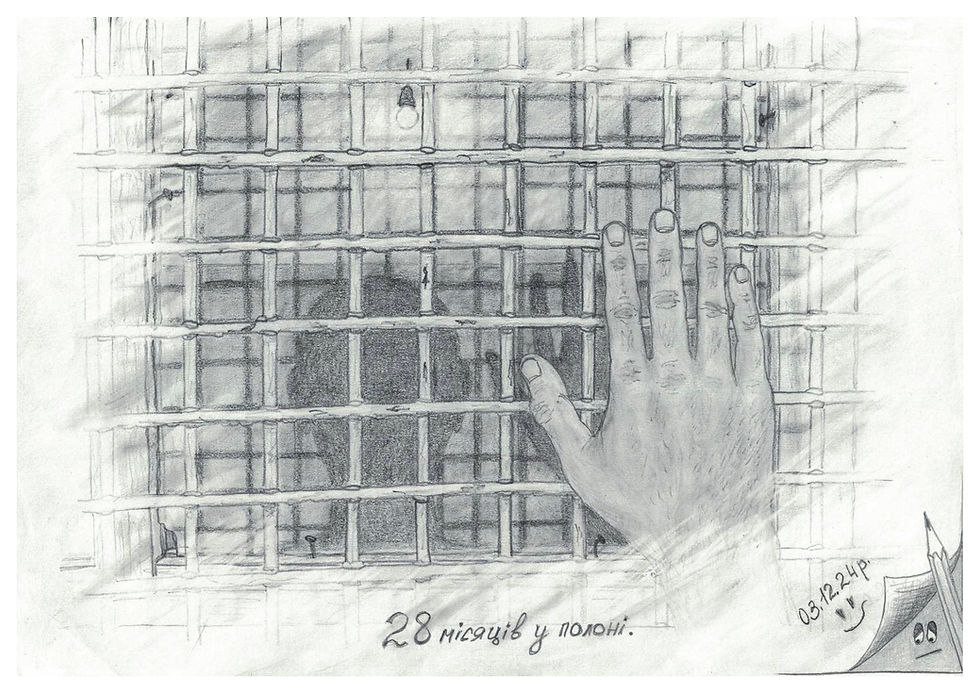
[1] Crimea resident detained for sharing information about military facilities with Security Service of Ukraine – FSB. Military news. 21.04.2025// https://www.interfax-russia.ru/military/news_eng/421804
[2] Unlawful criminal prosecutionof Ukrainian citizens in the Russian Federation and methods for protecting the rights of victims of such prosecution. 6 February 2025//Expert group Owl. https://www.savvamike.com/en/post/unlawful-criminal-prosecutionof-ukrainian-citizens-in-the-russian-federation-and-methods-for-protect
[3] Two saboteurs working for Ukrainian special services detained in Crimea — FSB. 23 January 2026//TASS. Russian News Agency. https://tass.com/society/2075835?utm_source=chatgpt.com
[4] Meduza: FSB has secret detention facilities in Crimea used to torture Ukrainians arrested on occupied territories. 26 May 2023//Novaya Gazeta Europe. https://novayagazeta.eu/articles/2023/05/26/meduza-fsb-has-secret-detention-facilities-in-crimea-used-to-torture-ukrainians-arrested-on-occupied-territories-en-news?utm_source=chatgpt.com
[5] Висоцька Тетяна Історія жінки, яку окупанти викрали й ув’язнили на Донеччині. 16.04.2025//Texty.org.ua. https://texty.org.ua/articles/114898/nelehaly-tak-okupanty-nazyvayut-bezpistavno-uvyaznenyh-v-sizo-cyvilnyh-ukrayinciv/; Тюссен Д. Українські цивільні в полоні РФ та їхні історії. 07.04.2026//DW. https://amp.dw.com/uk/ukrainski-civilni-v-rosijskomu-poloni-istorii-bolu-ocikuvanna-ta-borotbi/a-76694173; Вагнер Александра Почти 2000 incommunicado. Россия незаконно лишает свободы гражданских лиц. 08.03.2026//Радио Свобода. https://www.svoboda.org/a/pochti-2000-incommunicado-rossiya-nezakonno-lishaet-svobody-grazhdanskih-lits/33692889.html; Karmanau Yuras Life is harsh and dangerous in Russian-run parts of Ukraine, activists and former residents say. February 20, 2026//The Washington Times. https://www.washingtontimes.com/news/2026/feb/20/life-harsh-dangerous-russian-run-parts-ukraine-activists-ex-residents/
[7] Repression and Political Persecution in Occupied Crimea Continue in 2025. 6 July 2025//Межа. https://mezha.net/eng/bukvy/repression-and-political-persecution-in-occupied-crimea-continue-in-2025/
[8] Злочини, вчинені в період повномасштабного вторгнення РФ (станом на 23.05.2026)// Офіс Генерального прокурора. https://gp.gov.ua/
[9] НСЖУ презентує правовий аналіз ситуації з захистом прав цивільних полонених та їхніх родин. 30.10.2025//НСЖУ. https://nsju.org/novini/nszhu-prezentuye-pravovyj-analiz-sytuacziyi-z-zahystom-prav-czyvilnyh-polonenyh-ta-yihnih-rodyn/?fbclid=IwY2xjawSTj-hleHRuA2FlbQIxMABicmlkETFjZENaa3FEcWNITkg0RmY4c3J0YwZhcHBfaWQQMjIyMDM5MTc4ODIwMDg5MgABHlY4a6YBYwMblpohFXl_mXGT7l8x5DMX7anhs2wiDN4YS8R2mMQVq1fSkoAv_aem_YjDEzi5lqaS5Xia9iQsq0A
[10] Numbers and Evidence of Forcible Deportation of Ukrainians to Russia in the Russo-Ukrainian War//Where Are Our People? https://deportation.org.ua/numbers-and-evidence-of-forcible-deportation-of-ukrainians-to-russia-in-the-russo-ukrainian-war/
[11] Savva Mykhailo, Centre for Civil Liberties. ‘Filtration’ of Ukrainian citizens by the occupying forces. A form of violence on many levels. 7 March 2023// T4P. https://t4pua.org/en/1480
[12] Барабанов Илья, Лотарева Анастасия «Это не госизмена, это борьба со злом». Как двое россиян переехали в Украину, оказались в оккупации и стали помогать ВСУ. 29.04.2025//BBC News. Русская служба. https://www.bbc.com/russian/articles/cx2ye1p15pyo
[13] Дело № 8а-20637/2025 [88а-19613/2025]. Судебные акты. https://2kas.sudrf.ru/modules.php?name=sud_delo&srv_num=1&name_op=case&case_id=15522136&case_uid=7189dbf1-5e1e-45cd-8e1f-2141df453fed&new=0&delo_id=43
[14] The International Humanitarian Fact-Finding Commission//IHFFC. https://www.ihffc.org/
[15] Detention of civilians in the context of the armed attack by the Russian Federation against Ukraine. 24 February 2022 – 23 May 2023. 27 June 2023// OHCHR. https://www.ohchr.org/sites/default/files/2023-06/2023-06-27-Ukraine-thematic-report-detention-ENG.pdf Р. 8.
[16] Хочу к своим// https://hochuksvoim.com/ru
[17] Manisha Ganguly, Shaun Walker, Pjotr Sauer, Tetyana Nikolayenko, Anton Naumliuk, Artem Mazhulin and Lucy Swan Inside Taganrog: beatings, electrocution and starvation at prison where Ukrainians were tortured. 30 Apr. 2025//The Guardian. https://www.theguardian.com/world/2025/apr/30/inside-taganrog-beatings-electrocution-and-starvation-at-prison-where-ukrainians-were-tortured?utm_source=chatgpt.com
[18] Звичаєве міжнародне гуманітарне право. Норми// International Committee of the Red Cross. https://www.icrc.org/en/doc/assets/files/other/ukr-irrc_857_henckaerts.pdf
[19] Resolution on the human cost of Russia’s war against Ukraine and the urgent need to end Russian aggression: the situation of illegally detained civilians and prisoners of war, and the continued bombing of civilians//
[20] Resolution on four years of Russia’s war of aggression against Ukraine and European contributions to a just peace and sustained security for Ukraine// https://oeil.europarl.europa.eu/oeil/en/procedure-file?reference=2026/2599(RSP)
Comments